
Beyond the Taj Mahal: 7 Architectural Ways Makrana White Marble Can Transform Modern Spaces
Beyond the Taj Mahal: 7 Architectural Ways Makrana White Marble Can Transform Modern Spaces
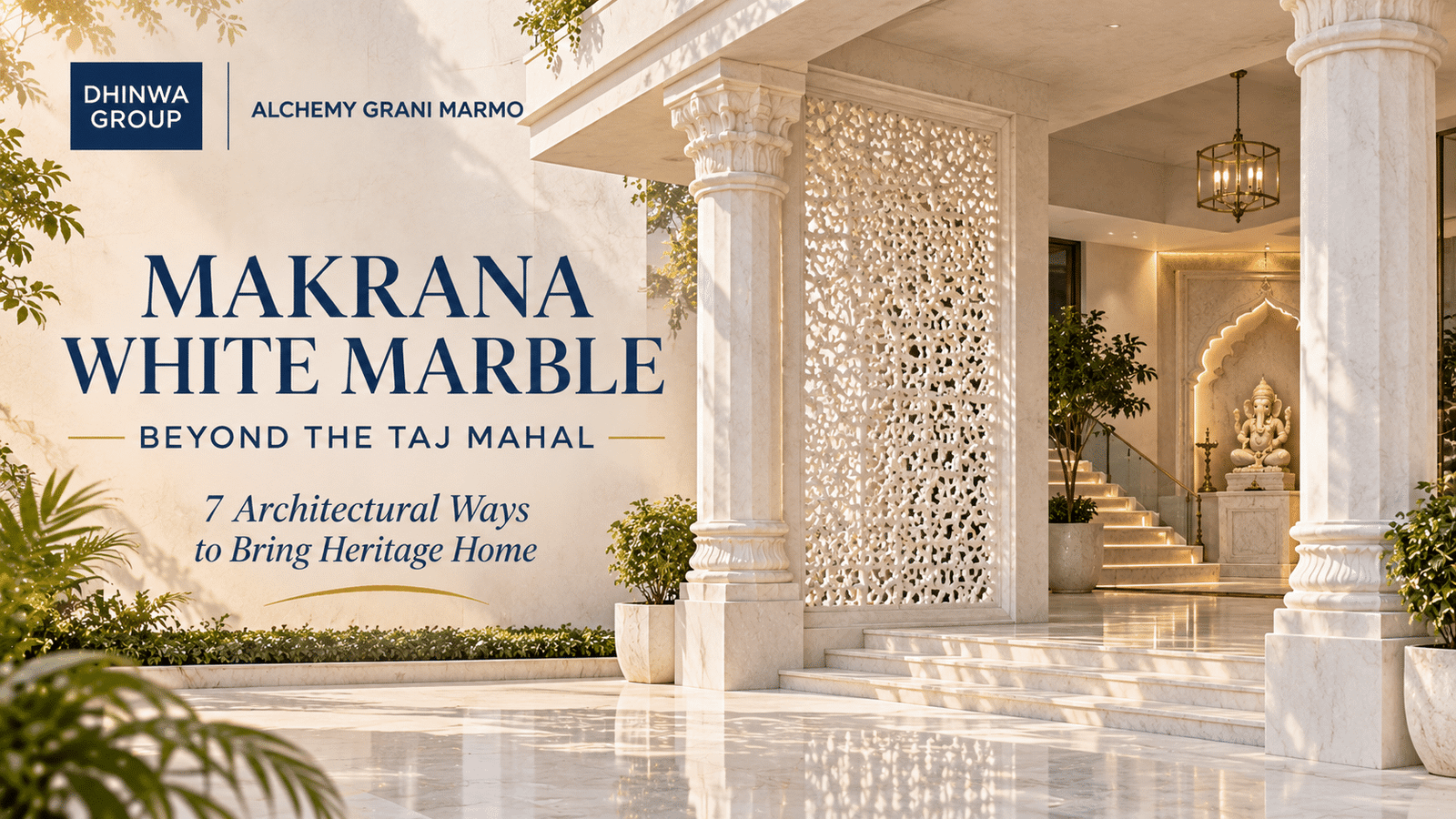
By Alchemy Grani Marmo Pvt. Ltd.
Published: 20 November 2026 · Last updated: 20 November 2026
Stand before the Taj Mahal at sunrise and the white does the talking. The marble glows before the sun touches it. It holds that glow past noon. The stone is Makrana White, cut from one hillside in Rajasthan. The building that made it famous is only the start of its story. In a modern home the same stone does seven jobs, and this guide walks through them in the order a visitor meets them — from the gate to the shrine room. Makrana White Marble Uses begin where the floor ends.
Quick Answer
Makrana White Marble Uses reach far past flooring. Columns carry the entrance on this stone. Its close calcite grain holds weight and carving at once. Carved screens filter light and air through it, in a craft the Taj Mahal’s own jali panels made famous. Wall panels dress a room in it. Mandirs rise from it. Staircases climb on it. Furniture gathers around it. Small carved details finish a house with it. Each use has a heritage proof — the Taj Mahal, the Victoria Memorial, the Sheikh Zayed Grand Mosque. Walk the seven stops below, and pick the uses that fit your home.
Key Takeaways
- The Taj Mahal made this stone famous, and its modern uses are the same seven crafts, brought home.
- A column needs weight and carving together, and Makrana’s close grain gives both.
- A carved screen is a wall that breathes: light, air and privacy in one panel.
- Wall panels hang on a frame, and the stone becomes the room’s skin.
- A home mandir is the stone at its most devotional, carved the way temple pillars were carved.
- Staircases, furniture and details take the floor’s own lot, so the house reads as one stone.
- Restoration teaches the care: clean gently, never with acid or abrasive, and the white outlasts generations.
Who This Guide Is For
Audience: households building or renovating a home, wanting one Makrana lot to carry the entrance, the screen, the shrine and the stair; architects and interior designers who specify Indian marble for more than floors; and homeowners planning a single feature that must match the floor stone for stone. Use cases: entrance columns and porticos, carved screens and partitions, feature and bathroom walls, home mandirs and pooja rooms, staircases, dining and console tables, sills, jambs and inlay details. Decision context: use it while the floor lot is still on the booking note and the entrance, screen and shrine are still undecided, when one lot has to cover several surfaces, and when the same stone must stay calm on a wall and sure underfoot on a stair.
The Seven Stops of Makrana White Marble Uses
Walk the house the way a visitor walks it. The gate first, then the screen, then the wall, then the shrine, then the stair, then the table, then the small details the hand meets last. Each stop carries two things: a heritage proof and a modern check. The proof shows which great building trusted the stone with this job first. The check shows what to look for before the order goes out. The table below holds the whole walk in one glance, and the sections after it take each stop in turn.
How to Read the Walk
Read each stop the same way. First, what does the stone do here that nothing else can? Second, which building proved it first? Third, what should the buyer check before the order goes out? Three questions, seven stops, one walk from the gate to the shrine.
| Stop | Where it sits | What the stone does | Heritage precedent |
|---|---|---|---|
| One — Columns | Entrance porch, courtyard, living room | Carries weight and carving in one shaft | The colonnades of the Taj Mahal; the great hall of the Victoria Memorial |
| Two — Carved screens | Windows, balconies, partitions, stairwells | Filters light and air, and guards privacy | The jali screens around the Taj Mahal cenotaphs |
| Three — Wall panels | Feature walls, TV walls, lift lobbies | Dresses the room in one field of white | The Victoria Memorial, Kolkata — a whole building in Makrana |
| Four — Mandirs | Pooja rooms and home shrines | Houses the shrine in carved white stone | Birla Mandir, Jaipur; Ram Mandir, Ayodhya |
| Five — Staircases | Halls, stairwells and landings | Climbs in the same white, cool underfoot | The courtyards and colonnades of the Sheikh Zayed Grand Mosque |
| Six — Furniture | Dining rooms, passages, living rooms | Anchors the room as table, console or bench | Carved Makrana furniture in the stone-cutters' record |
| Seven — Detailing | Sills, jambs, thresholds, inlay | Finishes the house one edge at a time | The pietra dura inlay of the Taj Mahal |
The table above holds the whole walk. The sections below take each stop in turn, from the gate to the shrine.
Stop One — Columns: The Stone That Carries
A column is the first thing a visitor meets, and the last thing a builder should rush. It stands in the open. It holds a beam or a roof above it. It carries the eye upward at the same time. Makrana White suits the job for a reason that sits inside the stone. Its calcite crystals locked together as they grew, each one holding its neighbours. So the shaft holds weight without splitting, and it holds a chisel’s edge without crumbling. A column asks both of the stone at once. Few white marbles answer both.
The Three Parts of a Column
Every traditional Indian column carries three carved sections, and each one does a different job. The base sits on the floor and takes the weather, the feet and the cleaning water. So the carver cuts it square or octagonal, and sets it with turned mouldings. The shaft rises between base and capital, and it is the part the eye reads: plain fluted, run with vines of lotus and mango leaf, or pierced with a fine jali pattern. The capital crowns the shaft and meets the beam. It carries the most carving — a lotus, a kalash, a cusped arch — because the eye rests on it. In a modern home the same three parts appear in simpler dress: a plain base, a fluted shaft, a quiet capital. The stone does not change between those two houses. Only the carving does.
What the Yard Checks Before a Column Is Cut
A load-bearing column is a discipline apart from decorative carving. The block must be free of hairline faults. A fault that hides in the yard opens under a lintel’s weight. The carver cuts the shaft on the vertical grain of the bed, so the crystals run with the load rather than across it. Then the carver turns the shaft true from every angle. A column that leans by a finger’s width shows it from the doorway. Ask the yard to show you the block before cutting, and to mark the grain direction on the back of the shaft. A decorative column for a porch or a console needs none of that engineering. The same check still keeps it straight.
Columns in a Modern Home
In a modern home, columns frame the entrance porch in pairs, six to seven feet tall, at a scale the body reads at once. They mark a courtyard colonnade. They hold up a pergola. They stand as a single pair beside a double door. Inside, a pair of plain polished columns can divide a living room from a dining room without a wall. A short decorative pillar can carry a console or a lamp in a passage. Keep the carving quiet where the house is modern, and let the white do the talking. The Taj Mahal’s colonnades and the Victoria Memorial’s great hall proved the same point at palace scale: a white column needs no colour to hold a room.
Stop Two — The Carved Screen: Light Cut in Stone
A jali is a wall that breathes. It is a panel of marble pierced through with a pattern — geometry, flowers, a tree of life — so light passes, air passes, and the eye stops at the pattern instead of passing through. The craft is old. The marble screens around the cenotaphs of the Taj Mahal rank among the most admired jalis in the world. The stone-cutters’ catalogues of the time record Makrana marble worked into jalis, filigree meshes carved from stone. A modern home borrows the same craft at a smaller scale, and the effect is the same: a wall that glows.
What a Screen Does
A screen does four jobs at once, and no other single panel does all four. It divides a room without closing it, so a living room and a dining room stay one space and two rooms at the same time. It filters the sun, so harsh afternoon light arrives as a pattern on the floor instead of a glare. It lets air move, so a stairwell or a balcony stays cool. And it guards privacy, because the pattern hides the room behind it while the room behind it still sees the light. That is why screens suit windows, balconies, staircases, partitions and facades alike. One panel, four jobs, and the stone never leaves the wall.
How a Screen Is Made Today
A screen begins as a panel cut from a slab, usually twenty millimetres thick. The carver draws the pattern on its face. In the old craft the carver cut each opening by hand, with a chisel and a drill, and a fine screen took weeks. Today a waterjet machine cuts the clean geometric openings, and a carver finishes the fine work by hand. So a screen keeps the hand’s touch without the old waiting time. The team then sets the panel in a frame — steel, wood or stone — and the frame carries the weight. A pierced panel must never carry a load of its own. Ask to see the pattern backlit before the order goes out. A screen is judged by its shadow, not by its face.
Where a Screen Belongs
In a modern home, a screen belongs where light needs managing and a wall would be too much. It stands between the entrance and the living room, so the door opens onto pattern instead of a bare wall. It fronts a balcony, so the evening sun arrives filtered. It guards a pooja room, so the lamp’s flame shows through the pattern without the room lying open. It dresses a staircase landing, where the light from a high window falls through it onto the steps. Keep the pattern simple where the room is small. Let one large screen do the work of three small ones. The Taj Mahal’s screens taught the rule: a fine pattern in white marble needs no colour to hold the eye.
Stop Three — Wall Panels: The Stone as Skin
The Victoria Memorial in Kolkata is the great proof of this use. Its whole body is Makrana marble. The builders chose it over European marbles after tests found the Indian stone superior. It has stood in Kolkata’s damp air for over a century, and it still reads white. A modern home borrows the same method at room scale, and the method is a hanging job, not a gluing job. Panels sit on a steel subframe. Stainless steel anchors hold them. A small gap behind them lets air move and moisture drain. Paste alone cannot hold a wall of stone, and mortar draws damp and salts straight into the marble.
How a Panel Wall Goes Up
Panel size follows weight, and weight follows height. Trade guidance sets the floor at twenty millimetres for hard stone panels below three point seven metres of height, and forty millimetres above it. Height adds leverage on the fixings, so a tall panel wants the extra thickness. Panels of eighteen to twenty millimetres fit feature walls, TV walls and lift lobbies in a normal home. The team cuts slots in the panel edges for the anchors. The first course goes on first, on a level bracket, and the team locks it before anything rises above it. Every panel above rests on the support beneath, so the first course carries the wall.
Joints and Pairs
Joints run narrow and even, filled with a sealant that cannot stain the stone. The width never changes across the wall, so the eye sees a single field of white instead of a grid. Where a panel is small and light and the wall behind it is sound, adhesive alone can hold it — but the installation team must agree first. A pair of panels cut from one slab and mirrored can turn a TV wall into one composition. That only works where the lot truly holds matching pairs.
Reading the White on a Wall
Light strikes a wall from the side, and Makrana’s white answers by sending it back across the room. Polish the wall and the daylight doubles; a narrow hall feels wider. Hone it and the same light spreads softly, with no glare; a bedroom or a pooja room likes that better. Set the pattern upright and the wall looks taller. Set it sideways and the wall looks wider. Make that choice at the yard, before cutting. Then stand the panels up in daylight and study them from the doorway before the cutting list is signed. The floor earns the same standing test.
Stop Four — The Mandir: The Stone at Its Most Devotional
No use of Makrana White carries more feeling than the mandir. The stone has housed shrines for centuries — the Birla Mandir in Jaipur, the Ram Mandir in Ayodhya, and countless home shrines across India. The craft is the same one that built temple pillars: carved columns, pierced screens, and a dome that rises in steps. A home mandir is that tradition at the scale of one room. It is the use where the stone’s whiteness matters most. White is the colour of the shrine, and Makrana’s white is the one the temples chose.
Why Makrana Suits a Shrine
A mandir asks three things of its stone, and Makrana answers all three. It must stay white beside a lamp’s flame, day after day. The stone’s near-pure calcium carbonate holds its white without yellowing. It must take carving, because a shrine is carved at every edge — pillars, arches, a stepped dome. The close crystal mosaic holds a fine edge. And it must feel cool and calm to the touch, because a devotee kneels and touches the stone every morning. The marble’s natural coolness serves the shrine room too. It is the same coolness that keeps a Makrana floor comfortable in summer. That is why the temple builders reached for it first, and why home shrines still do.
The Parts of a Home Mandir
A home mandir is built from the same parts as a temple, at a smaller scale. Two carved pillars carry the front. A pierced jali panel guards the sides. A stepped dome or a carved arch crowns the top. The base is a solid plinth, often with a small step, and the back panel carries the deity’s seat. Each part comes from the same lot, so the white matches from the pillar to the dome without a seam of doubt. Ask the yard to cut the mandir from the same lot as the floor. Keep the carving quiet where the room is small. A fine pattern reads better than a crowded one when the shrine stands a few feet from the eye.
Keeping a Mandir White
A mandir stays white by habit, not by effort. Wipe the stone with a soft dry cloth after the morning lamp, so soot never settles into the carving. Keep oil and kumkum off the face. Clear any mark the moment it lands. Brush a carved panel dry, never with a wet cloth, so no water sits in the carving. Seal the stone before anyone uses it. Renew the seal when water stops beading. The restorers of the Taj Mahal teach the same lesson at monument scale: a gentle hand, repeated often, keeps white marble white for centuries.
Stop Five — The Staircase: The Stone Underfoot, Upright
Step onto a Makrana tread barefoot and the stone tells you its first secret: it stays cool. That coolness is the same quality that keeps a Makrana floor comfortable in a hot afternoon, and it is the reason the stone suits a staircase. The second secret is grip. A tread must hold a foot in the dark, on a narrow edge, while the house carries on around it. Makrana’s close grain holds the edge, and a leathered face holds the foot. The staircase is the stop where the stone works hardest, and the stop where its coolness shows most.
The Tread, Built Up
Makrana slabs come in sixteen, eighteen and twenty millimetres. A supported interior stair calls for a thirty-millimetre tread and a twenty-millimetre riser, by the trade benchmark. So the workshop builds the tread up. It laminates two thicknesses together, or it beds a twenty-millimetre tread fully and adds a mitred apron at the edge, so the tread reads thicker than it is. A floating flight, with no bed beneath it, calls for forty to fifty millimetres. The riser takes no traffic, so twenty millimetres keeps it light. Before any stone is cut, the surveyor takes the finished rise of the concrete core. Five millimetres wrong on one step, and the whole flight loses its rhythm.
The Nosing and the Finish
Every footstep meets the nosing first. It is the tread’s front edge, projecting past the riser. Round it into a bullnose or a half-bullnose, and each footfall spreads across a curve. Leave it square and sharp, and the corner chips first — then the chip grows. Cut two or three shallow grooves near the nosing, about two millimetres deep, and the foot finds grip without the look changing. Finish decides the rest. Polish turns slick under wet feet. Hone the tread, or leather it, and the foot holds. Take leathered for the tread, honed as the gentle second choice, and save polish for floors and pooja spaces. Then order the staircase from the floor’s own lot. Two lots will show as two whites, one warmer, every morning. One lot will not.
Light Down the Flight
A stairwell reads from above, step by step. Light drops down the flight, and Makrana’s white sends it back generously, so the stairwell stays bright with no extra lamps. Its soft pattern gives each tread a direction: the flow travels with the flight, never across it. Carry the same lot up the stairwell walls as well, and the flight becomes one piece of stone from the hall to the landing. The Sheikh Zayed Grand Mosque shows the same idea at a grand scale. Its courtyards and colonnades wear Makrana marble, and one white runs across every surface until the whole building reads as a single stone.
Stop Six — Furniture: The Stone at the Table
A marble top turns a dining table into the room’s anchor. Makrana White fits the job for the same reasons it fits a floor: a quiet white field, a pattern that stays soft, and a surface a stonemason can polish again when life marks it. The stone-cutters’ catalogues record Makrana worked into furniture for generations — tables, benches, carved seats. The modern home keeps the same habit: a dining top, a coffee table, a console for the passage, each one cut from a smaller piece of the same lot.
The Base Comes First
A marble-topped dining table is heavy. A large one can weigh two hundred and fifty to three hundred and ten kilograms. So choose the base with the top, never after it. Steel legs hold it. Solid wood legs hold it. Hollow metal or plastic cannot. The top wants at least twenty millimetres for a home. Anything thinner chips under impact. Where a solid slab cannot reach the room, or the floor below cannot take the load, a marble veneer answers — a thin skin of real stone over a rigid, light core. Check the doorway and the lift before the workshop cuts. A table that cannot reach its room will never be used.
Meals Leave Marks
Lemon, wine, tomato sauce, coffee — every acid a kitchen holds will find the table. So the household’s habits choose the finish. Hone the top and the small etches and scratches a household leaves all but disappear. Polish it and every mark shows. A sealer only buys time to wipe; it grants no immunity. Set coasters under hot plates and glasses. Wipe every spill at once. Reseal about once a year. The reward is permanence. A stonemason can hone the top back and polish it again for decades. A chip takes a resin fill and a colour match until the repair all but vanishes. No printed lookalike can be given a second life.
Small Pieces, Second Jobs
Furniture is where the lot’s smaller pieces earn their keep. The dining top, the console, the side table by the sofa — each one comes from the part of the slab the floor could not take. A coffee table from the same lot as the floor ties the room together without a word. Its white matches the floor beneath it. Ask the yard to hold the offcuts back when the floor is cut, and to mark which piece belongs to which room. A table from the same lot as the floor is no second purchase. It is the same stone, set to a second job.
Stop Seven — Architectural Detailing: The Smallest Carving, the Loudest Signature
The last stop is the smallest. Sills, jambs, thresholds, skirting and inlay panels are the stone your hand meets a dozen times a day. They are where a careless builder hides a cheap edge. Makrana White handles these details well. Its pattern stays quiet. A sill wants no drama. It wants a clean edge and a calm white. Alchemy’s own Makrana page names these uses in plain words — wall cladding and treads, door and window sills, jambs, kitchen countertops, bathroom and vanity tops — and the names read like a walk through one house.
Inlay, the Taj's Quiet Lesson
The Taj Mahal’s most admired detail is not a wall or a dome. It is the pietra dura inlay — flowers and vines cut from coloured stones and set into the white marble, so fine that the joints all but disappear. A modern home borrows the same craft at a smaller scale: a thin inlay border around a floor, a floral medallion at the centre of a hall, a narrow band of inlay along a wall panel. The craft needs a stone that holds a fine edge, and Makrana’s close mosaic does. Keep the inlay quiet — one border, one medallion — and let the white carry the room. The Taj teaches the rule: the detail should reward a close look, not shout from the doorway.
The Edges That Meet the Hand
Run a finger along a sill and you learn the house in one touch. Leave an edge square and unsealed, and it chips in the first year. Round it to a pencil edge, seal the face, and it lasts the life of the house. A threshold meets every foot that enters. A window sill meets rain, sun and a sliding door. Both want stone that will not move, and both usually come from the pieces the floor and the staircase left over — the lot’s smaller cuts, set to a second job. Every joint wants the same care: jamb to wall, sill to frame, threshold to floor. Fill each one with a sealant that cannot stain the stone, and check them all once a year.
The Detail That Dates a House
A house shows its age in its details, not in its floors. A chipped sill edge, a stained joint on a jamb, a threshold from another lot — each one tells a visitor the house was finished in a hurry. Keep every detail in the floor’s lot. The house then reads as one stone from threshold to shrine. Take a detail from another lot, and the eye will catch the mismatch each time it passes the door. That is the last stop of the walk, and the simplest rule in this guide: one lot, seven uses, and the details done last, done right.
Seven Buildings That Prove the Point
The seven stops of this walk are not new ideas. Each one was proved at monument scale, centuries before any modern home borrowed it. The table below holds the record — seven buildings, seven proofs, one stone:
| Building | Built | What Makrana does there |
|---|---|---|
| Taj Mahal, Agra | From 1632 | Clads the mausoleum, frames the jali screens, carries the pietra dura inlay |
| Victoria Memorial, Kolkata | 1906–1921 | The whole building, chosen over European marbles after testing |
| Sheikh Zayed Grand Mosque, Abu Dhabi | 1994–2007 | Marble courtyards, colonnades and halls, listed among its stones |
| Moti Masjid, Lahore | 1630–1635 | A white marble mosque in the Mughal tradition |
| Birla Mandir, Jaipur | Completed 1988 | A temple built in white Makrana marble |
| Ram Mandir, Ayodhya | Consecrated 2024 | Makrana marble among the stones of the new temple |
What the Record Proves
The record proves two things a buyer should carry into the yard. First, the stone has already passed every test this guide sets. It has carried columns, filtered light, dressed walls, housed shrines, climbed stairs, topped tables and finished doorways, at the largest scale anyone has ever asked of it. Second, the stone has outlasted every building around it. The Taj Mahal has stood for nearly four centuries, the Victoria Memorial for over one, and both still read white in the morning light. A home built from the same stone, from the same deposit, inherits that record — not as a promise, but as a fact the buyer can stand beside.
Makrana White at a Glance
The stone’s own record decides what each stop can ask of it. Makrana White Marble Uses rest on these facts. The right-hand column turns each one into workshop language:
| Fact | What it means for architecture |
|---|---|
| Composition | Ninety to ninety-eight percent calcium carbonate — the near-pure white that holds its colour beside a lamp's flame |
| Crystal structure | A close mosaic of interlocking calcite crystals — it holds weight on a column and a chisel's edge on a screen |
| Family | One of only two calcitic marble varieties in India — the mineral reason the stone takes a mirror polish |
| Deposit | Five steeply dipping bands, remade as marble some one thousand four hundred and fifty million years ago — one hillside, a family of whites |
| Ranges | Doongri, Devi, Ulodi, Chosira, Kumari, Pahar Kua — addresses inside the bands; ask for the range on the booking note |
| Recognition | GI tag 2015; IUGS Global Heritage Stone Resource 2019 — the first stone from India and Asia to hold it |
| Standard | IS 1130 caps absorption at 0.4 percent by weight and sets minimum hardness 3 on the Mohs scale — the benchmark a lot is judged against |
| Finishes | Polished, honed, leathered, sandblasted (per the stone's own page) — leathered for treads, honed for mandirs and screens, polished for columns, panels and tables |
| Slab thickness | 16, 18 and 20 mm — columns and screens are built up from these, walls hang in them, tables top out at 20 mm |
| Best uses | Columns, carved screens, wall panels, mandirs, staircases, furniture, detailing — the seven stops in this guide |
The Geology Behind the Seven Stops
Geology sets the stage for all seven stops. The short version runs like this: limestone, buried and heated until its crystals locked into marble. Wikipedia’s full account of Makrana marble carries the long version. Makrana’s telling of that story adds a rare distinction: of all the marbles India quarries, only two are calcitic, and Makrana stands among them. The deposit is a single hillside at Makrana, in Rajasthan. Five bands dip steeply through it, laid down long ago as part of the Ajmer Formation and remade as marble some one thousand four hundred and fifty million years ago. The bands carry names — Doongri, Devi, Ulodi, Chosira, Kumari, Pahar Kua — and each one holds its own mix of trace minerals. That is why one deposit yields a family of whites, not a single white, and why one lot must serve one house.
What the Restorers Teach a Modern Home
Restorers have cleaned the Taj Mahal four times in living memory — in 1994, in 2001, in 2008, and again from 2014. Each time they used the same gentle method. They pasted Fuller’s earth, the clay called Multani mitti, onto the marble in a thick layer. They left it to dry. They washed it off with distilled water. The drying clay draws the grime, the grease and the pollution out of the stone, and the wash carries it away. No acid, no abrasive, no machine. The Archaeological Survey of India chose the method because it cannot harm the stone. The same method now cleans monuments in other countries too. The lesson for a modern home is simple: white marble is kept white by a gentle hand, repeated often, not by a harsh treatment applied once.
The Restorer's Four Habits
First, clean with water and a pH-neutral stone soap, and nothing stronger. Acids — lemon, vinegar, descalers — dissolve the polished surface itself, and no sealer stops that change. Second, wipe a spill the moment it lands. Dry the stone after the morning routine, so mineral rings never form. Third, seal every surface before anyone uses it. Renew the seal when water stops beading — roughly once a year for a honed face, less often for a gloss one. Fourth, dust carved work with a soft brush. Never let water sit in a carving. Four habits, borrowed from the restorers, and the white in your home ages the way the Taj Mahal’s white has aged: slowly, and with grace.
At the Yard: The Offcut Wall
The yard keeps a low wall by its gate, no taller than a doorstep. Seven offcuts from a single Makrana slab stand on it in a row, and they end more debates than any brochure. A column capital, a pierced jali offcut, a wall panel, a mandir pillar, a tread, a tabletop and a sill — each one cut from the same lot, each one finished the way its use demands. The capital is polished, the jali is honed, the panel is polished, the pillar is honed, the tread is leathered, the tabletop is polished, the sill is leathered. One slab, seven finishes, seven jobs.
One Slab, Seven Answers
A buyer stands before the wall and sees the whole walk at once. The white holds across all seven pieces, because the stone never left the slab. Light falls through the jali offcut and lands on the tread below it, the way it will fall in the buyer’s own stairwell. The mandir pillar stands beside the tabletop, and the two whites are one white. That is what the wall is for. One lot, seven uses. The lot that serves all seven is the lot for the house.
The Booking Note
The booking note lists each piece with its use beside it — no single finish for the whole house. Columns polished, screen honed, panels polished, mandir honed, treads leathered, table polished, sills leathered. Seven stops from one lot, each set to its job. Bring your room list and your staircase measurements. The wall shows the rest.
Keeping Each Use at Its Best
The Daily Habits
- Columns and screens: wipe the shafts and the pierced panels once a week with a soft damp cloth. Study the joints once a year. Renew shrunken sealant once a year, so damp never creeps behind the stone.
- Wall panels and details: brush carved panels with a soft brush. Wipe sills with a damp cloth. Check every sealant joint once a year.
The Wet Rooms, the Table and the Shrine
- Staircase: brush the treads each morning. Wash them weekly in warm water with a stone-safe cleaner. Shoes bring grit in, and grit wears the nosing faster than feet do. Test the seal by dripping a little water on the stone. Renew it when the drops stop beading. Never leave a wet mop standing on a polished tread.
- Furniture: set coasters under hot plates and glasses. Wipe every spill at once. Reseal the top about once a year. Always lift plates and trays instead of sliding them, so no dragged edge cuts a line the stone remembers.
- Mandir: wipe the stone with a soft dry cloth after the morning lamp, so soot never settles into the carving. Keep oil and kumkum off the face. Wipe away any mark the moment it lands.
One Rule for Every Stop
- One habit covers all seven stops: seal every surface before the household moves in. Acid treats every finish alike. A sealer only buys time against a stain. It never stops one. Wipe a spill at once, and the stone forgives you.
- Never drag furniture. Drag a chair leg over a tread or a tabletop, and the stone holds the mark. A polished face shows the mark.
Frequently Asked Questions
Can Makrana White marble be used for columns?
Yes. It suits columns well. Its close, interlocking calcite crystals hold weight without splitting and hold a chisel’s edge without crumbling, so one shaft can carry a beam and a carving at once. Cut the shaft on the vertical grain of the bed, from a block free of hairline faults, and keep the carving quiet where the house is modern. In a modern home, columns frame the entrance porch in pairs, six to seven feet tall, or divide a living room from a dining room without a wall.
Is Makrana White marble suitable for a carved screen or jali?
Yes, and it is one of the stone’s oldest uses. The marble screens around the cenotaphs of the Taj Mahal rank among the most admired jalis in the world, and the stone-cutters’ catalogues record Makrana worked into jalis and filigree meshes. A modern screen divides a room without closing it, filters harsh sun into pattern, lets air move, and guards privacy in one panel. Ask to see the pattern backlit before the order goes out, and set the panel in a frame that carries its weight.
Can the same Makrana lot serve the floor, the staircase and the mandir?
Yes — and one lot should serve all three. Makrana White Marble Uses work best from a single lot. One lot holds one white for the floor, the treads, the risers, the mandir pillars and the wall panels, so the house reads as one stone, not several buys. Ask the yard to pencil the flow arrow on each slab’s back before dispatch. Ask them to cut the staircase, panels and mandir from the floor’s own lot. Order from a second lot, and the second white will show under the same light.
How is Makrana White marble used in the Taj Mahal?
The Taj Mahal, built from 1632 under Shah Jahan, is clad in Makrana marble. The stone travelled some three hundred kilometres from the Makrana quarries in Rajasthan, under imperial orders that sent masons and carts from the domain of Raja Jai Singh. It dresses the mausoleum’s walls and domes, frames its carved jali screens, and carries its pietra dura inlay — flowers and vines cut from coloured stones and set into the white marble. The same deposit still supplies the stone today. The Archaeological Survey of India has cleaned the monument with gentle Multani mitti mud packs, in 1994, 2001, 2008 and from 2014.
What finish suits Makrana White on stairs, screens and mandirs?
Leathered suits stair treads best. Its soft texture grips underfoot and hides the dust a day brings in. Honed is the gentle second choice for stairs, and the usual choice for mandirs and screens, because it hides small marks almost completely. Save polished finishes for entrance columns, wall panels and dining tops that see daily attention. The finish follows the use’s job, not the slab’s picture.
Where in Bengaluru can buyers plan Makrana White uses past the floor?
Visit the Alchemy yard at Koppa Gate, on Bannerghatta Main Road in Bengaluru. It keeps full Makrana lots standing in open daylight. By the gate stands an offcut wall of seven pieces, cut from a single slab. Walk the seven stops in miniature there. Stand the wall panels upright. Carry the staircase measurements and the room list with you. Call +91 9148982071 to fix a time to visit.
The Stone, Beyond the Taj Mahal
That is the walk. Seven stops, one lot, and a stone that has already proved each use at the largest scale anyone has asked of it. Columns that carry, screens that breathe, walls that dress a room, a mandir that holds the day’s first light, a staircase that climbs in the same white, a table that holds the room, and details that carry the stone’s manners to the last edge. Plan these Makrana White Marble Uses together, from one lot, and the house will read as one stone from gate to shrine. The floor was where the story started. The stone reaches your home straight from the quarry — NATURE IS FOREVER.
Plan Your Makrana White Uses at the Yard
Come and stand before the offcut wall at Koppa Gate. It settles the seven uses in one quiet minute. The same lot stands beside it, ready for the columns, the screen and the shrine. Start with the Makrana White Marble product page — the stone’s full specification lives there — then open the guide to Makrana white marble for the stone’s ranges and grades in full. Begin here:
- Visit the Yard at Koppa Gate — on Bannerghatta Main Road, Bengaluru, Karnataka 560105
- Call +91 9148982071 and Ask for a Makrana White Uses Plan — for your rooms, your staircase and your shrine
- Write to the Yard Team — sales@alchemygranimarmo.com — with your staircase measurements and room list